

“During my Master’s in Clinical Psychology, I encountered several concepts that drew me back to my yoga education and the philosophies I’ve long tried to embody. In this space, I’d like to explore two such concepts—one rooted in Psychology and the other in Yoga—that initially appeared similar, yet reveal significant differences in both philosophical depth and practical application.”
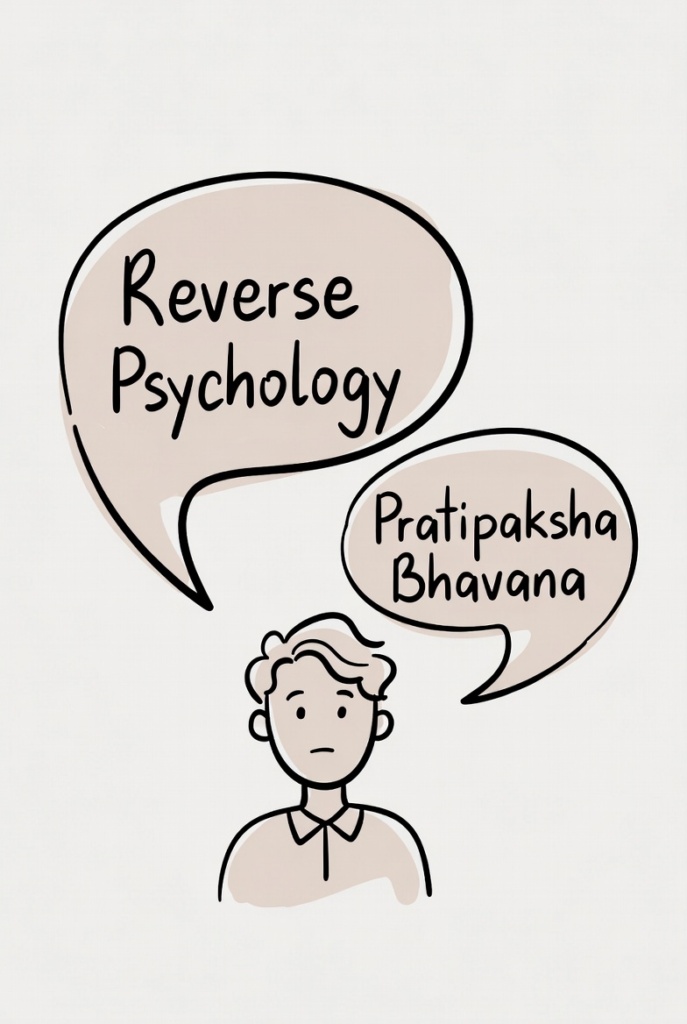
“Reverse psychology uses opposition to influence behavior, whereas Pratipakṣa Bhāvana uses conscious ethical counter-cultivation to purify mental tendencies. One manipulates reaction; the other transforms samskāra.”
Reverse psychology and yogic philosophy might seem like they come from entirely different worlds—one rooted in clever mental strategy, the other in ancient spiritual discipline—but they share a surprisingly similar starting point: both work by shifting the mind’s habitual patterns. Reverse psychology nudges a person toward a desired outcome by inviting them to resist it, revealing how the mind often rebels against direct instruction. Yogic concepts, especially those found in practices like pratyahara (withdrawal of the senses) or vairagya (non‑attachment), also challenge the mind’s automatic reactions, but through awareness rather than resistance. Where reverse psychology leverages the mind’s tendency to push back, yoga encourages observing that impulse until it dissolves. One plays with the ego; the other transcends it. Together, they highlight a fascinating truth: transformation often begins not by forcing the mind, but by understanding how it behaves when gently redirected. Reverse psychology manipulates resistance, whereas yogic methods either replace, transcend, witness, or exhaust mental tendencies to bring lasting freedom.

A comparison chart between Reverse Psychology patterns with yogic concepts
| # | Concept | Domain / Tradition | Core Mechanism | How it Handles “Opposite” or Resistance | Ego / Self Involvement | Manipulation? | Outcome Goal | Modern Parallel | Key Distinction from Reverse Psychology |
|---|---|---|---|---|---|---|---|---|---|
| 1 | Reverse Psychology (Baseline) | Modern psychology / Behavioral science | Suggest or encourage the opposite to provoke reactance | Actively triggers resistance (“If you forbid it, I’ll do it”) | High – exploits ego, autonomy defense | Yes (tactical, often interpersonal) | Achieve specific behavior/outcome | N/A (it’s the reference) | Exploits existing tendencies without changing them |
| 2 | Pratipakṣa Bhāvana (Yoga Sūtra 2.33) | Classical Yoga (Patañjali) | Consciously cultivate the ethical opposite when disturbed by negative thoughts (vitarka) | Direct replacement: anger → compassion, greed → generosity | Low – self-directed reconditioning of saṁskāras | No | Ethical reconditioning, harmony with dharma | Cognitive Behavioral Therapy (CBT) – but with spiritual/ethical depth | No provocation or ego-play; builds wholesome patterns inwardly |
| 3 | Vairāgya (Dispassion) (Yoga Sūtra 1.15–1.16) | Classical Yoga | See desire/attachment clearly and fully → natural dissolution | Non-confrontational: observe desire completely instead of suppressing or indulging | Minimal – clarity removes fuel | No | Freedom from compulsive pulls | Mindful detachment practices | Removes the fuel rather than provoking reaction; allowance through insight |
| 4 | Sākṣī Bhāva (Witness Consciousness) | Yoga / Meditation traditions | Withdraw identification; observe thoughts/emotions as they arise | Non-interference: “fight less → dissolve faster” by not owning the movement | None – you are the observer, not the content | No | Loss of momentum in mental patterns; toward liberation (kaivalya) | Mindfulness-Based therapies (e.g., MBSR) | Allowance + detachment, not opposition; thoughts fade from lack of fuel |
| 5 | Neti Neti (“Not this, not this”) | Advaita Vedānta | Systematic negation: reject false identifications to reveal the Self | Indirect revelation through removal (define by what it is not) | Transcended – ego identifications are peeled away | No (paradoxical inquiry, not persuasion) | Direct realization of true nature | Apophatic approaches in philosophy / deconstruction in therapy | Removal leads to truth, not indirect persuasion or behavioral trick |
| 6 | Tantric Understanding (Līlā / Spanda – playful vibration of consciousness) | Tantra / Non-dual traditions | Allow full expression of mind-movement within steady awareness | Radical allowance: give space → natural exhaustion of the play | Minimal – awareness remains untouched | No (requires maturity & guidance) | Emotion/thought completes its arc and self-liberates | Somatic experiencing, radical acceptance therapies | Spacious embrace instead of control; mature non-resistance |
Quick Visual Summary
- Reverse Psychology → Exploits the mind’s rebellious streak (short-term tactic, ego-driven).
- Yogic Approaches → Dissolve the root tendencies through awareness, ethics, observation, negation, or allowance (long-term transformation, ego-transcending).
The yogic methods share a subtle “reverse” flavor (e.g., non-fighting anxiety makes it subside faster, or allowing desire to be seen weakens it), but they operate from non-manipulative depth — turning toward truth rather than gaming behavior.
When you dig deep a deeper Side-by-Side Insight unfolds
- Reverse Psychology → Pushes against the mind’s wall (ego says: “You can’t control me!”) → Short spark, but reinforces the same tendency long-term.
- Pratipakṣa Bhāvana → Replaces the wall with a beautiful window → Actively builds new, wholesome neural/energetic pathways. Ethical, intentional alchemy.
- Vairāgya → Shines a bright light on the wall until it becomes transparent and irrelevant → No fight, no replacement — just clear seeing starves the desire. Subtle non-action reversal.
- Sākṣī Bhāva → Steps back so far the “wall” is just a passing cloud in the sky of awareness → Ultimate non-interference: non-fighting = fastest dissolution. Feels paradoxically “reverse” because effort drops.
Quick reference to remember the terms
- Reverse Psychology — 🔴 Provoke to control
- Pratipakṣa Bhāvana — 🟢 Heal by choosing opposite virtue
- Vairāgya — 🟡 See clearly → attachment evaporates
- Sākṣī Bhāva — 🔵 Rest as witness → everything self-liberates
I hope this exploration offers you a fresh lens to understand the mind—whether through the strategic twists of reverse psychology or the steady, transformative clarity of yogic wisdom. May these insights support you on your journey toward greater awareness, balance, and inner mastery. It certainly helped me.